

Jul 02, 2026Posted by Kevin Miller to Play Blu-ray
Quick Summary
The all-new multi-disc Blu-ray converter has been completely discontinued. If you still find vintage hardware devices on the second-hand market, the Sony ES BDP-CX7000ES and the Sony BDP-CX960 are good choices. Besides, modern home theater enthusiasts prefer to transfer physical disc collections to local NAS systems. Paired with a Plex player and high-fidelity software, this setup delivers a seamless, uninterrupted movie marathon experience.
For die-hard enthusiasts of physical discs, the nostalgic appeal of the classic "physical CD player" era is unmatched—simply pressing a button instantly plays a vast collection of films, delivering a tactile experience. However, modern home theater enthusiasts face a frustrating dilemma: when attempting to watch the complete expanded trilogy of The Lord of the Rings consecutively, there are virtually no new multi-disc Blu-ray players available on the market. This article will recommend suitable multi-disc players and delve into the challenges they present.

Table of Contents
- Part 1. How We Chose These Players
- Part 2. Why are Multi-disc Players So Rare Today
- Part 3. Top 2 Multi-disc Blu-ray Players
- Part 4. Bonus Information about The Death of the Mega-Changer
- Part 5. Hardware Mega-Changers vs. Digital NAS Streamlining
- Part 6. The Modern Alternative: Your DIY 4K Jukebox Blueprint
- Part 7. FAQs about Multi-disc Blu-ray Player
Part 1. How We Chose These Players
Finding and evaluating multi-disc Blu-ray players requires a radically different approach than reviewing standard, modern tech gear. Since the industry has completely shifted away from mechanical mega-changers, our curations for the remaining legendary models—specifically the Sony ES BDP-CX7000ES and the Sony BDP-CX960—are guided by a strict, specialized framework.
Our Evaluation Criteria
To give you the most honest and practical look at these legacy giants, we analyzed them across five critical dimensions:
- Disc Capacity: The physical volume of optical media the internal carousel or rack can securely hold and index simultaneously.
- Build Quality: The durability of the internal motors, chassis shielding against electrical noise, and the longevity of the laser pick-up assembly.
- Video Output: The maximum video resolution and upscaling capabilities (noting the legacy 1080p limitations).
- Audio Support: Compatibility with high-res surround sound codecs (Dolby TrueHD/DTS-HD Master Audio) and the inclusion of premium analog outputs.
- Availability & Market Risk: How frequently these units appear on secondary markets and the difficulty of sourcing replacement parts.
Data Sources & Methodology
Because these hardware units are no longer rolling off factory lines, standard retail testing is impossible. Instead, our research methodology relies heavily on aggregated secondary data:
- Online Marketplace Research: Continuous monitoring of historical and current pricing, seller descriptions, and unit conditions across platform aggregates like eBay, Audiogon, and specialized vintage electronics liquidators.
- User Forum Analysis & Community Feedback: Deep-diving into decades of archived owner threads on enthusiast hubs like AVSForum, Reddit’s /r/hometheater, and Hi-Fi collector communities to track common long-term hardware failures, belt degradation patterns, and DIY repair success rates.
Crucial Limitations Disclaimer
Please be advised: Because all hardware mentioned in this guide is discontinued, our assessments are strictly based on historical performance specifications, long-term user community feedback, and secondary market reliability data. We have not conducted hands-on testing with brand-new, factory-sealed units, as none exist. The actual performance and lifespan of any vintage mega-changer you purchase will depend entirely on how well the previous owner maintained its delicate internal mechanics.
Part 2. Why are Multi-disc Players So Rare Today
When discussing optical disc hardware, the industry generally splits players into two camps: those built for convenience and library management and those built for pure sonic or visual fidelity.
1. Multi-disc Carousels & Mega-changers
These units, famously exemplified by the Sony CDP-CX455 (400-disc) or the Pioneer Elite File-type players, were designed to act as a 'physical jukebox' for a household.
- Primary Goal: Storage and continuous playback.
- Mechanism: Carousels: Usually hold 3–5 discs on a rotating platter.
Mega-changers: Use a massive internal rack (often circular or 'beehive' style) where a robotic arm or 'shuttle' fetches the selected disc and places it on the laser assembly. - User Experience: They allow for 'shuffle' mode across an entire collection. High-end models often included keyboard inputs or serial ports to name tracks and categorize genres.
- Trade-offs: Mechanical Complexity: The robotic parts are prone to failure over decades, and a single mechanical jam can trap your entire collection.
Signal Integrity: Because the chassis is massive and filled with moving plastic parts, it is more susceptible to internal vibrations and electrical noise.
2. Single-disc High-end Players
Units from brands like Esoteric, Accuphase, McIntosh, or Marantz (Reference Series) focus on the 'one disc, one performance' philosophy.
- Primary Goal: Maximum fidelity and signal purity.
- Mechanism: Typically a heavy, over-engineered tray or a top-loading design. The transport mechanism is often made of machined aluminum or steel to minimize 'jitter' (timing errors) and resonance.
- Hardware Quality: DACs: They use premium Digital-to-Analog Converters, often in 'Dual Mono' configurations.
Power Supply: Massive toroidal transformers to ensure the motor's electrical noise doesn't bleed into the audio signal. - User Experience: Intentional and tactile. These players are designed for 'critical listening' sessions where the listener interacts with one album at a time.
- The Philosophy: By removing the robotic arms and storage racks, the manufacturer can spend the entire budget on the laser's precision and the analog output stage.
| Feature | Mega-changer (e.g., Sony 400) | High-end Single Player |
| Capacity | 50 to 400+ Discs | 1 Disc |
| Complexity | High (Robotic/Moving Parts) | Low (Focus on Precision) |
| Chassis | Large, often thin-walled metal | Heavy, shielded, anti-resonant |
| Audio Quality | Consumer Grade / Mid-fi | Audiophile Grade / Hi-Fi |
| Best Use Case | Parties, Background Music | Critical Listening, High-end Systems |
| Longevity | Difficult to repair (mechanics) | Highly serviceable (electronics) |
Part 3. Top 2 Multi-disc Blu-ray Players
We prepared the best Blu-ray disc players that can hold multiple discs simultaneously for continuous streaming. We also include all the information you need regarding the hardware’s price, features, and overall performance.
Note
Please be advised that 400-disc Blu-ray players are no longer in production. All hardware currently available on the market is either used or refurbished. Please exercise caution when purchasing.
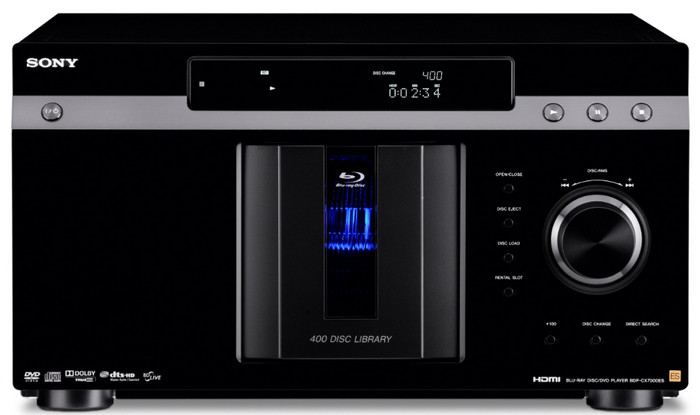
1. Sony ES BDP-CX7000ES
400 discs
Blu-ray discs, DVDs, and CDs.
1080P
HDMI, Component Video, Composite Video, S-Video.
A jacket-art on-screen display makes it simple to search and sort discs.
$1894.12
The Sony ES BDP-CX7000ES represents the absolute pinnacle of the physical media jukebox era. As part of Sony’s prestigious 'Elevated Standard' line, it pairs a massive 400-disc capacity with premium build quality, beefy linear power supplies, and onboard HD Reality Enhancer processing. In 2026, it remains a highly sought-after trophy for hardcore audiophiles and vintage AV collectors. However, its sky-high price on the used market is difficult to justify for average users: it tops out at 1080p resolution, lacks 4K UHD capabilities, and any failure in its complex robotic transport could result in an expensive, unrepairable paperweight.
Pros
- Audiophile-grade construction with 7.1 discrete analog audio outputs for legacy high-end amplifiers.
- Superior 1080p upscaling and video processing compared to the standard CX960 model.
- Includes RS-232C serial control and IR inputs for advanced home automation system integration.
Cons
- Exorbitantly expensive on the secondary market, often costing as much as a brand-new, top-tier 4K player and NAS combined.
- Completely blind to modern 4K Ultra HD Blu-ray discs.
- Extremely high mechanical complexity with obsolete custom ES-grade parts, making repairs nearly impossible today.
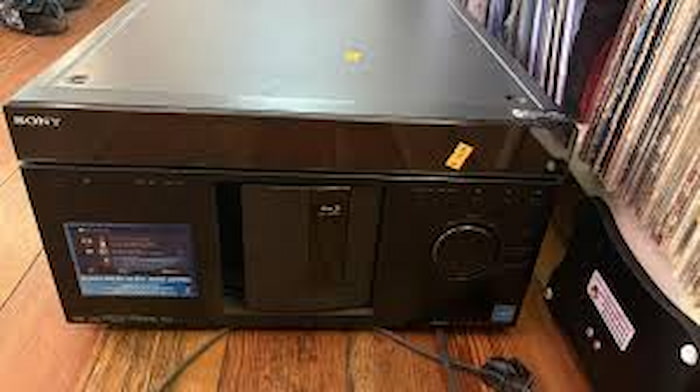
2. Sony BDP-CX960
Blu-ray Disc, DVD
1920×1080
HDMI
HDMI
Surround
Supported Audio Format
~$350-$1200
For physical-media purists who refuse to let the streaming era win, the Sony BDP-CX960 remains a nostalgic monument to home-cinema history. Acting as a physical jukebox for your living room, this 400-disc mega-changer allows you to organize a massive library of 1080p Blu-rays and DVDs without constantly swapping plastic cases. However, in 2026, welcoming this 30-pound behemoth into your rack comes with major caveats: it lacks 4K UHD capabilities entirely, and its intricate network of aging rubber belts means mechanical troubleshooting is a matter of when, not if.
Pros
- Seamlessly houses and cycles up to 400 standard Blu-rays and DVDs simultaneously.
- Features Ethernet connectivity to automatically fetch movie metadata and cover art (where supported).
- Widely available on the secondary market (eBay) at a fraction of its original launch price.
Cons
- It is strictly limited to 1080p and fails to read or play modern 4K Ultra HD Blu-ray discs.
- It has a slow disc-loading time.
- High risk of mechanical failure with scarce replacement parts and zero official manufacturer support.
Part 4. Bonus Information about The Death of the Mega-Changer
The era of the 400-disc ‘Mega-Changer’ was a brief, ambitious moment in home cinema history. While the dream of having an entire library available at the touch of a button was revolutionary, the reality of living with these behemoths often felt like maintaining a vintage car – rewarding when it worked, but prone to catastrophic breakdown.
As someone who has tracked the evolution of physical media from the first Sony ‘Disc Explorer’ interfaces to the modern era of high-bitrate streaming, it is clear that the Mega-Changer didn’t just die; it was outpaced by its own mechanical complexity and the rapid shift to 4K.
1. The Achilles' Heel: Mechanical Fragility
The most significant pain point was always the complexity of the carousel and loader mechanism. To manage 400 discs, these players relied on a dense network of plastic gears, rubber belts, and precise optical sensors.
- The 'Disc Trap': If a disc became slightly misaligned or a belt lost its tension (a common issue as the rubber aged), the mechanical arm could jam or, worse, scratch a rare disc.
- Repair Nightmare: Today, finding replacement belts or specialized optical pickups for units like the Sony BDP-CX7000ES is nearly impossible. Once the mechanical 'logic' fails, the unit often becomes a 30-pound paperweight.
2. The Sound of Progress (or Lack Thereof)
Early adopters will vividly remember the mechanical cacophony of a disc swap.
- The 'Clunk-Whir' Cycle: Changing from disc 1 to disc 200 could take upwards of 30 to 90 seconds. The loud mechanical grinding of the carousel spinning into place was far from the silent, 'instant-on' experience we expect today.
- Operational Noise: Even during playback, the internal cooling fans and the vibration of a 400-disc payload often created a hum that could be heard during quiet movie scenes.
3. The 4K UHD Ceiling
The final nail in the coffin was the lack of 4K Ultra HD support.
- Mega-changers peaked during the 1080p Blu-ray era. When the industry pivoted to 4K UHD, the hardware requirements changed significantly.
- 4K discs are more sensitive to vibration and require more precise laser pickups. No manufacturer was willing to invest the R&D required to build a 400-disc changer capable of handling the tighter tolerances of 4K triple-layer discs.
Experience Note: In the mid-2000s, these units were the pinnacle of 'luxury tech.' However, the industry learned that moving parts are the enemy of longevity. The transition to digital 'ripping' and media servers (like Plex or Kaleidescape) wasn't just about convenience; it was a necessary escape from the mechanical limitations of the disc carousel.
The absolute death of the 400-disc changer left a massive power vacuum in high-end home theaters. Audiophiles refused to compromise on physical disc bitrates, yet loathed the manual disc-swapping routine. This tension sparked a digital revolution, shifting the pursuit of an uninterrupted 'Physical Jukebox' away from fragile robotic gears and toward high-speed silicon and network storage.
Part 5. Hardware Mega-Changers vs. Digital NAS Streamlining
For most modern power users, their thoughts have shifted from 'Which used changer should I buy on eBay?' to 'How do I digitize my collection?' Standard single-disc universal players (like a Panasonic UB820) are perfect for occasional viewing, but for true marathon sessions, maybe building a localized digital streaming cluster is the superior way.
Here is the comparison of two different ways:
| Feature | Legacy Mega-Changer (e.g., Sony ES) | Modern NAS + Streaming Server |
| 4K UHD & HDR Support | No | Yes |
| Loading Speed | Slow (30–90 seconds mechanical swap) | Instantaneous (1–3 seconds buffer) |
| Physical Risk | High (Laser failure, jammed/scratched discs) | Low (Discs are ripped once and safely stored) |
| Library Management | Obsolete text interfaces or dead servers | Modern, rich UI with trailers, cast info, and art |
| Scalability | Hard-capped at 400 slots per giant chassis | Limitless (Add larger hard drives to the pool) |
Part 6. The Modern Alternative: Your DIY 4K Jukebox Blueprint
Since brand-new hardware changers are gone, how do you achieve the ultimate uninterrupted movie night without constantly leaving your couch? The answer lies in a hybrid hardware-and-software blueprint that pairs local storage with premium playback tools.
1. The Core Infrastructure: NAS + Plex / Kodi
Instead of keeping 400 plastic cases spinning inside a noisy metal box, tech-savvy collectors now use a NAS (Network Attached Storage) enclosure (such as a Synology or Asustor) paired with high-capacity enterprise drives. By using a cheap UHD-friendly optical drive on your PC, you can rip your physical Blu-rays into 1:1 bit-perfect MKV or ISO files.
- Plex / Kodi: These platforms act as your digital jukebox interface, organizing your movies with stunning poster art, actor profiles, and background music, accessible from any screen in your house.
2. The Ultimate Playback Terminal: Blu-ray Master Free Blu-ray Player
While network streaming apps are great for TVs, managing and previewing your massive library directly on your workspace or dedicated Home Theater PC (HTPC) requires specialized decoding power. This is where Blu-ray Master Free Blu-ray Player (Windows/Mac) shines as the critical final link.
Rather than setting up complex network protocols just to watch a movie on your computer, this software allows you to mount your backed-up Blu-ray ISO images or folders directly from your NAS storage pool.
Free Download
For Windows
Secure Download
Free Download
for macOS
Secure Download
- Uncompromised Quality: It bypasses standard streaming compression, delivering the raw, cinematic 4K video bitrate and high-res surround sound encoded on the original disc.
- Flawless Playlists: You can easily queue up multiple ISO files—allowing you to create custom movie marathons (like back-to-back franchise sequels) with zero physical interruptions, effectively resurrecting the spirit of the Sony Mega-Changer on your desktop.
Part 7. FAQs about Multi-disc Blu-ray Player
-
What is the best multi disc player?
If money is not a problem, you should go for a high-end multidisc player that supports Blu-ray, DVDs, and CDs for endless streaming. But keep in mind that you need other high-end equipment to reach the best video and audio quality for home entertainment.
-
Do they make DVD players to play multiple DVDs?
Yes. You can find DVD players that can hold multiple discs at once. From the same brand, Sony offers DVP-CX777ES and DVP-NC600. There are more options to find online, such as Onkyo DV-CP704 and Pioneer DV-F727.
-
Are Blu-ray discs obsolete?
Rather than being obsolete, Blu-ray has only declined in usage around the world because of more usage of streaming platforms like Netflix, HBO, Hulu, Amazon Prime Video, and so on. Despite what is happening, Blu-ray and DVD are still relevant for collectors and enthusiasts.
-
What will replace Blu-ray players?
It is difficult to know which platforms or devices can take over Blu-rays. However, many suggest that streaming services will likely get the top seat because of the 4K Ultra HD and HDR streaming distribution. Nonetheless, it will take more decades before Blu-ray becomes outdated.
-
Are there any 4K UHD multi-disc changers available on the market?
No. As of today, no company manufactures a true 4K UHD multi disc changer. The category effectively died after Blu-ray megachangers disappeared.
-
Multi-disc Blu-ray player vs. ripping to a NAS — which is better for home theater?
A NAS is generally better for convenience, speed, and reliability. Multi-disc players are slower, mechanical, and no longer supported. A NAS setup requires more initial work but delivers a far smoother long term experience.
-
Is the Sony BDP CX7000ES still worth buying in 2025?
Only for collectors or niche use. It’s limited to 1080p Blu-ray/DVD, has aging hardware, and replacement parts are scarce. For most users, it’s not a practical choice anymore.
-
Why did Sony stop making 400-disc players?
Demand collapsed as streaming, digital libraries, and NAS-based playback became dominant. The hardware was expensive, bulky, and prone to mechanical failure, making it unprofitable to continue.
Wrapping up
After reading this article, you may have gained a full understanding of the multi-disc Blu-ray player. The two recommended tools can meet your needs for playing multiple discs at once. Besides, you can try the alternative way for a more convenient Blu-ray watching experience.
More from Blu-ray Master
Top Blu-ray Player
Easily play Blu-rays, DVDs, and various video/audio formats with rich playback features.
100% Secure. No virus